Friend Dan Earl, The Family History Guy, shares tips for caring for old grave markers.
We've all seen them during our cemetery visits. We may have some for our ancestors.
How do we take care of them? Dan shares his tips in this edition of "Gettin' By with Help From Our Friends".
5 Tips for Caring for Old Grave Markers
Spring is here and those of us who live up north are thawing out, and with the quarantine restrictions and there has been a renewed interest in visiting cemeteries. If you are new to the cemetery visiting crowd, which traditionally has been us, genealogists, and goth kids, you will probably notice that some markers have held up better over time than others. That is just nature taking its course. These markers are outside, and things left outside for two-hundred or more years are going to accumulate some dirt, moss, and mildew. The more you visit the cemetery the more these dirty markers are going to gnaw at the moral center of your brain, and you will want to clean them, but where to begin? Here are five tips to help you clean gravemarkers.
Tip One. Before you do anything else. Take pictures of everything.
This may seem like an odd place to start, but it is more essential than you may realize. By documenting the cemetery now, you are creating a digital record of the cemetery that will last for a long time. A tree limb could fall on a marker and destroy it, and your digital photo may be the only evidence it ever existed. Not a photographer, you say? Have no fear. You can download an easy-to-use app like BillionGraves or the Find-a-Grave app to take the pictures and upload them on the spot for other users to index. This is also a fun activity for youth to get involved in doing something genealogically related.
Tip Two. Do No Harm.
What works for medical doctors works for cleaning gravemarkers. It is better for you to leave it dirty than to try to clean it and end up damaging the stone. Never use household cleaning products like bleach or ammonia on a gravemarker unless you have been trained by a professional on how to use these chemicals properly and in the right dilutions. I have even heard of people using shaving cream, rug cleaner, metal scouring pads, drain clogging liquid, and so many more things that leave me shaking my head. Instead of putting on a lab coat and goggles, invest in a biological masonry cleaner like D2 (www.d2bio.com), which is available for purchase online, and then follow the directions carefully.
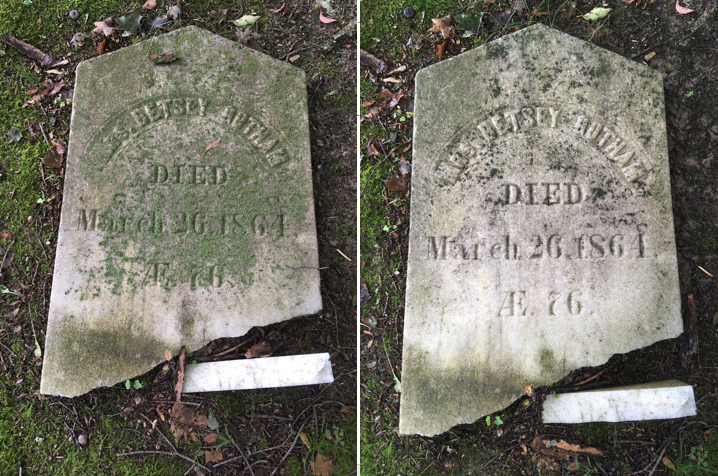
Tip Three. Be Patient.
Good cleaning takes time. If you are using D2, you will need to walk away for a couple of days and then come back to see the difference. You will be tempted to use harsher methods to clean the markers faster. Do not do this. If you do, I will find you. (Please read that last sentence in Liam Neeson’s voice). If you have a hard time being patient, and if you’re not sure just ask your spouse, or would have a hard time physically cleaning the marker, find someone who is patient, and has the physical ability to do so. There is no need to do a rush job with harsh chemicals because you physically cannot do the work. Cleaning a gravemarker is like taking a laxative, you never start with the highest dosage first! Start small and be patient.
Tip Four. Break old habits.
For years people have done two things that are no longer recommended practices. I have had people walk out of lectures and workshops when I share these, so brace yourself for some controversy. First, do not use tin foil to make a reverse cast of the marker. Though it may not seem like it, you are doing microscopic damage to the marker, leaving small, unnoticeable scratches on the surface. Over time water will seep into those microscopic scratches you made and when that water freezes, it expands. Fast forward twenty years and your tin foil cast have destroyed the marker. Second, do not do grave rubbings. Can they be done safely? You bet. Are they regularly done safely? No. Tape residue, over rubs, ripping through the paper, chipping the stone, all of these occur with enough frequency that you should not do it. Instead, take pictures and use image-editing software like Vivid-Pix (www.vivid-pix.com) to enhance the photos. You will be surprised at how well this no-touch approach works.
Tip Five. Know when to call in the pros.
There are two times when I recommend you call in the pros. There is a lot of physical damage to the marker or there are a lot of markers to clean. Never attempt to make a repair to a stone or metal marker using cement, epoxy, glue, or anything else. These repairs can rarely be undone. You need to find a professional cemetery conservator, like me (https://www.familyhistoryguy.net/cemeteryhelp.html), to do that work. If you are unaware of one in your area, contact me and I can help you find one. If there is not a lot of repair work, but just a lot of cleaning that needs to get done, and by a lot, I mean more than 25 markers, contact a professional cleaning and restoration company like ERS in Columbus Ohio (https://www.ers-us.com/stores/ers-of-columbus-and-se-ohio/), they can use dry ice to clean the markers quickly, safely, and efficiently. Here is an example of how a Civil War monument was cleaned using dry ice.

So, head on out to your local cemetery today and see what needs to be done. You’ll fall in love with these special places like I have.
Thanks so much, Dan! We'll be ready the next tie we make a cemetery visit.
Bio:

I got my start in family history at age 10 when my father took me to the grave of my great-grandfather; that sparked a lifetime of interest in family history. I have spent the last 25 years researching my own family history and helping others make history a part of their story. The Family History Guy,
What about you? Do you have old grave markers that need attention?
Have you tried to clean or preserve them?
Share your experiences,
We'd love to hear from you!